El IVAM recorre su propia historia, que cuenta la del arte moderno y contemporáneo
The Institut Valencià d’Art Modern (IVAM), housed in the Julio González Centre, presents The IVAM Collection Today, a permanent exhibition that traces the evolution of Valencian, Spanish and international modern and contemporary art through a fresh and forward-looking interpretation of art history
Header images: © Miguel Lorenzo-IVAM
IVAM reimagines its collection through nearly 500 works presented from a variety of perspectives. Led by Blanca de la Torre, who took over as director of the museum in March 2025, and curated by the institution’s team of conservators, the new display embraces a hybrid exhibition model. It offers a historiographical reading of the major artistic movements of the 20th and 21st centuries through a chronological framework, while simultaneously weaving together four thematic routes centred on colour, ecology, feminism and conflict. “The exhibition seeks to move beyond the traditional linear narrative, encouraging multiple stories, critical intersections and spaces for dialogue between history and the microhistories that emerge from the particularities of the museum’s holdings,” explains a representative of the institution.
Recognising that the collection has largely been shaped by the study of European art history, the curatorial team has also reflected on issues of gender, race and class imbalance within the collection, as well as on historical omissions. This process has enabled them to construct new narratives and redefine the archive as an ecosystem of memories shaped by artists, critics, curators, gallerists, collectors and many other cultural agents.
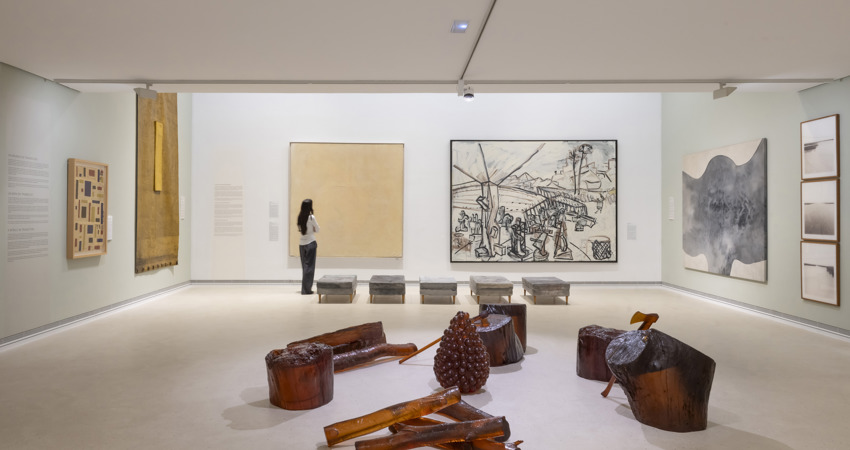
IVAM’s collection to date © Miguel Lorenzo-IVAM
The IVAM collection began to take shape in 1984 with the acquisition of works by Spanish artists such as Antoni Tàpies and Eduardo Arroyo, as well as Valencian figures including Equipo Crónica. However, its founding milestone came in 1985 with the incorporation of a major group of works by Julio González, the central figure around whom the IVAM collection is built. Positioned at the heart of modernity, González brought together craftsmanship and industry, the figurative and the abstract. His work in Paris and collaborations with artists such as Picasso and Brancusi enabled the museum to contextualise the historical avant-gardes and establish a foundation for the collection. From there, IVAM expanded to include early 20th-century avant-garde movements such as Futurism, Cubism and Surrealism and, owing to its own history, amassed a significant number of works in unconventional formats, including artists’ books, photomontages, drawings, prints and maquettes, giving rise to a particularly fascinating museology.
It is thanks to this approach that IVAM holds one of Europe’s finest collections of Soviet art, featuring outstanding examples of poster design and photomontage, as well as an exceptional group of works from the Bauhaus and the parallel Dutch movement De Stijl. The collection also includes a significant representation of European Informalism and Abstract Expressionism, reflecting the political climate and historical upheavals of the 1930s and 1940s. Artists such as Joan Miró, Marcel Duchamp, Paul Klee, László Moholy-Nagy, Alexander Calder, Lee Krasner and Adolph Gottlieb are all represented, forming a historical thread that traces the remarkable legacy of the avant-garde.
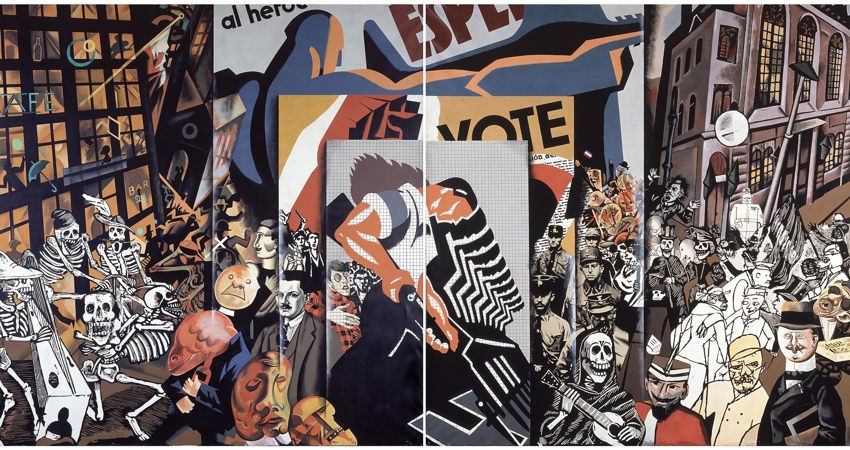
Equipo Crónica. El Panfleto, 1973. IVAM Institut Valencià d´Art Modern, Generalitat
As the narrative moves into the second half of the 20th century, IVAM explores Spanish art under the Franco dictatorship, including the role of the Hispano-American Biennials organised by the Institute of Hispanic Culture, which helped drive the renewal of Spain’s artistic scene. Works by Spanish artists such as Antonio Saura and Andreu Alfaro appear alongside photography and film. The journey then leads to the emergence of Pop Art, a revolution represented by figures such as Richard Hamilton and Valencian artists including Amparo Segarra and Ángela García Cordoñer.
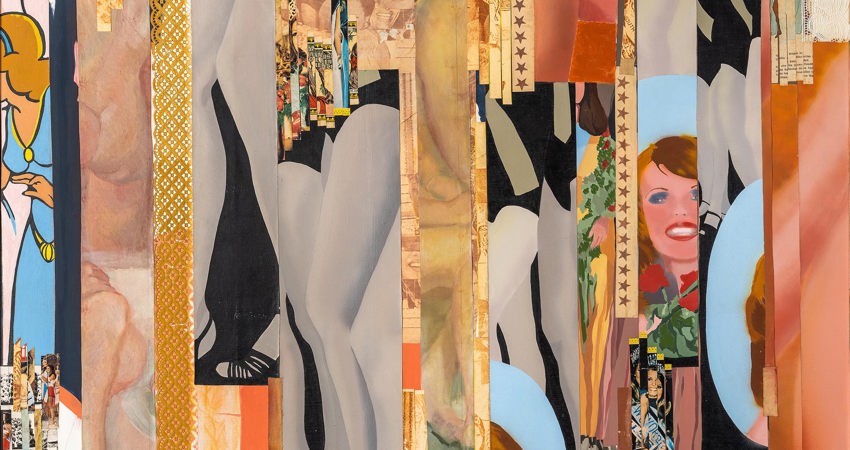
Ángela García, Composición, 1974. IVAM Institut Valencià d´Art Modern, Generalitat
The final section of the exhibition reaches contemporary art, spanning from the 1980s to the present day, when new conversations emerge surrounding bodies and feminism, globalisation and processes of displacement, ecology, conflict and identity. It is also here that new artistic formats come to the fore, including installations and interventions, represented by figures such as Robert Smithson, renowned for his spiral earthworks, and Martha Rosler, the multidisciplinary artist whose work has long focused on amplifying women’s voices.
Beyond its historical dimension, the exhibition’s alternative routes propose contemporary readings in retrospect, allowing visitors to explore themes such as the aesthetic dimension of violence, the sensory and symbolic experience of colour, the representation of sexual diversity and the social significance of climate crises through works created decades ago. It is precisely because of IVAM’s longstanding commitment to these conversations – and particularly to sustainability – that the exhibition design was commissioned to Smart & Green Design, a studio specialising in eco-design and environmental auditing for exhibitions, ensuring that the display meets today’s ecological standards.
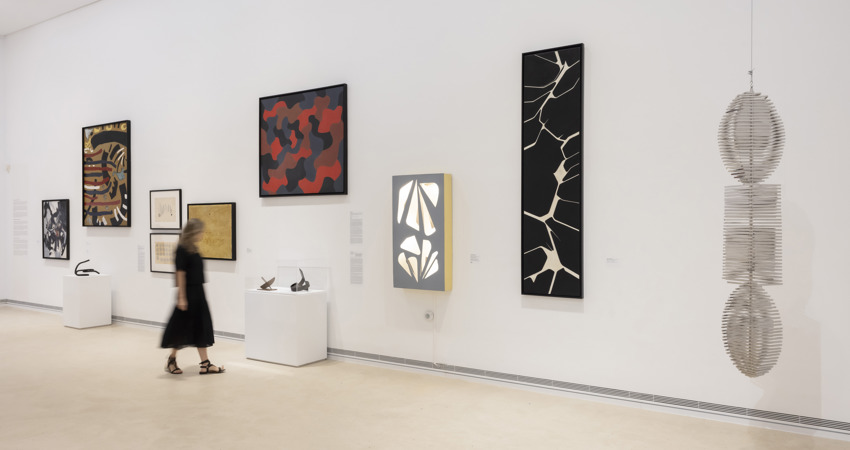
IVAM’s collection to date © Miguel Lorenzo-IVAM