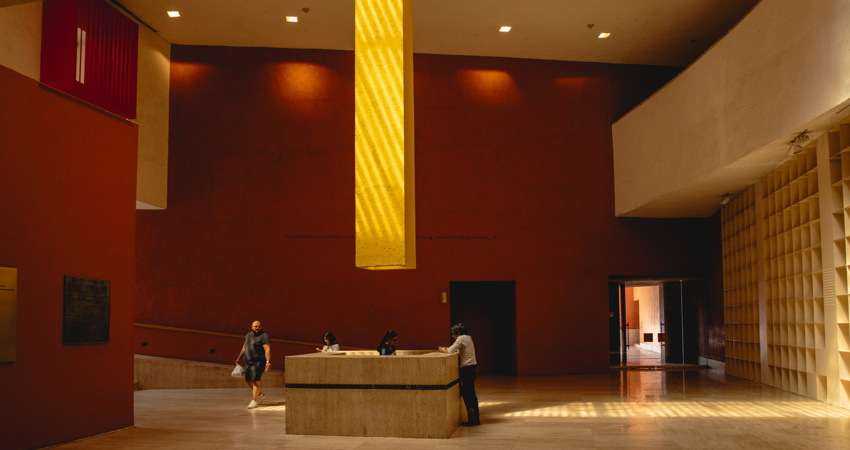
A sanctuary of inspiration
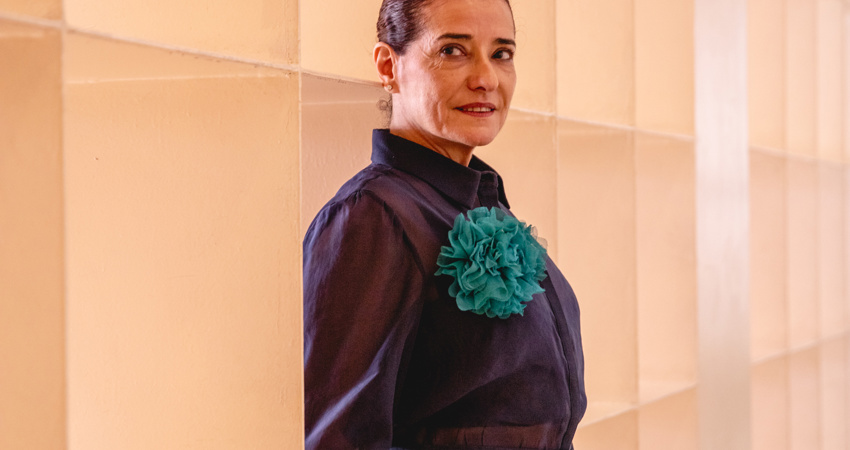
Taiyana Pimentel, director of the Museo de Arte Contemporáneo de Monterrey (MARCO) since 2019 and one of the most influential curators on the Latin American scene, invites us into the institution, which is unique in both form and substance. You can fly direct from Madrid to Monterrey from 2 June from 20,000 Avios.
Text: Jesús Huarte
Photos: Joseph Fox
What do you consider MARCO’s greatest contribution to the international contemporary art scene over its 35-year history?
Since its founding, MARCO has aimed to serve as a platform for contemporary Latin American art in one of Mexico’s most dynamic economic, financial and industrial cities – positioning itself as an institution attuned to globalisation. At the same time, it has consistently sought to function as an alternative space for education, engaging audiences across northern Mexico and the border region.
How would you describe its discourse and mission today?
Over the years, MARCO has been shaped by three key curatorial directions. The first, during its initial seven years, was closely tied to the artistic discourse that emerged across the Americas in the 1980s – exploring themes of origins, identity and memory. A defining example was its landmark inaugural show, Myth and Magic: Art of the Eighties, followed by a display of art from Oaxaca, and presentations of North American artists such as David Hockney and of Latin American figures who had gained prominence in exhibitions such as Magiciens de la Terre (held in 1989 at the Centre Georges Pompidou and the Grande Halle de La Villette in Paris), including José Bedia and Julio Galán.
Subsequently, the museum underwent an update, presenting exhibitions that engaged with post-conceptual concerns in art. During this period, MARCO tended to bring in shows produced elsewhere in the world, rather than generating its own discourse as it had in its early years. Over the past six years, however, we have sought to return to that capacity for production from the north, recognising that contemporary art in Mexico today is very different from what it was in the 1990s. Today, it enters into dialogue through its artists at major international biennials – even Documenta. Our artists have developed a discourse that is global in origin and inherently international in scope. We have also recognised a generation of artists that had yet to be fully revisited in Mexico – Damián Ortega, Pedro Reyes, Miguel Calderón, Teresa Margolles – and have set out to reexamine their work, while simultaneously creating space for the art that has emerged from the north of the country and its relationship with the border.
How is the region represented?
We have presented career surveys of artists such as Mario García Torres, Colectivo Tercerunquinto and Colectivo marcelaygina, as well as, more recently, the exhibition Nuevo León: The Future Is Not Written. Bringing together 13 photographers from different parts of the world, each connected by their engagement with representations of Monterrey and its metropolitan area, the show explored ways of interpreting, constructing memory and shaping identity in this place.
Since your arrival at MARCO in 2019, you’ve worked extensively to turn the museum into a living space that actively engages local audiences.
This has taken shape under my direction, but with the visibility of an entire team that understands the north – again, in its relationship to the border – while also recognising Monterrey as a city where the power of academic thought is deeply significant, and one that has historically been an industrial gateway connecting the country to the world.
Cultural positioning had slowed, so we turned to strategies such as collaborating with local music movements that had already gained international recognition – most notably the Avanzada Regia. In doing so, we were able to attract younger audiences who might otherwise feel that the doors of a museum like this are not open to them. That barrier has been gradually broken down year after year, with growing access to the galleries among audiences drawn in by large-scale concerts, fostering a meaningful coexistence across social classes and among diverse professional groups.
Another key strategy has been partnering with companies such as LEGO to develop forward-thinking educational programmes aimed at younger audiences, as well as hosting exhibitions such as one by Oscar Murillo, which inherently invites collective participation as part of its curatorial approach. Murillo’s participatory murals became a repository for the memories and narratives of migrant communities in present-day Monterrey, while also giving voice to political perspectives and themes of violence.
Until 9 August, visitors can discover at MARCO the FEMSA Collection, one of Mexico’s most important private collections of Latin American art.
We have developed strategies to revisit private collections that are contributing to the analysis of artistic heritage in dialogue with contemporary art frameworks. Collections from the north – such as those of Isabel and Agustín Coppel, as well as the FEMSA Collection – are enriching the way the history of contemporary exhibitions is constructed at MARCO.